
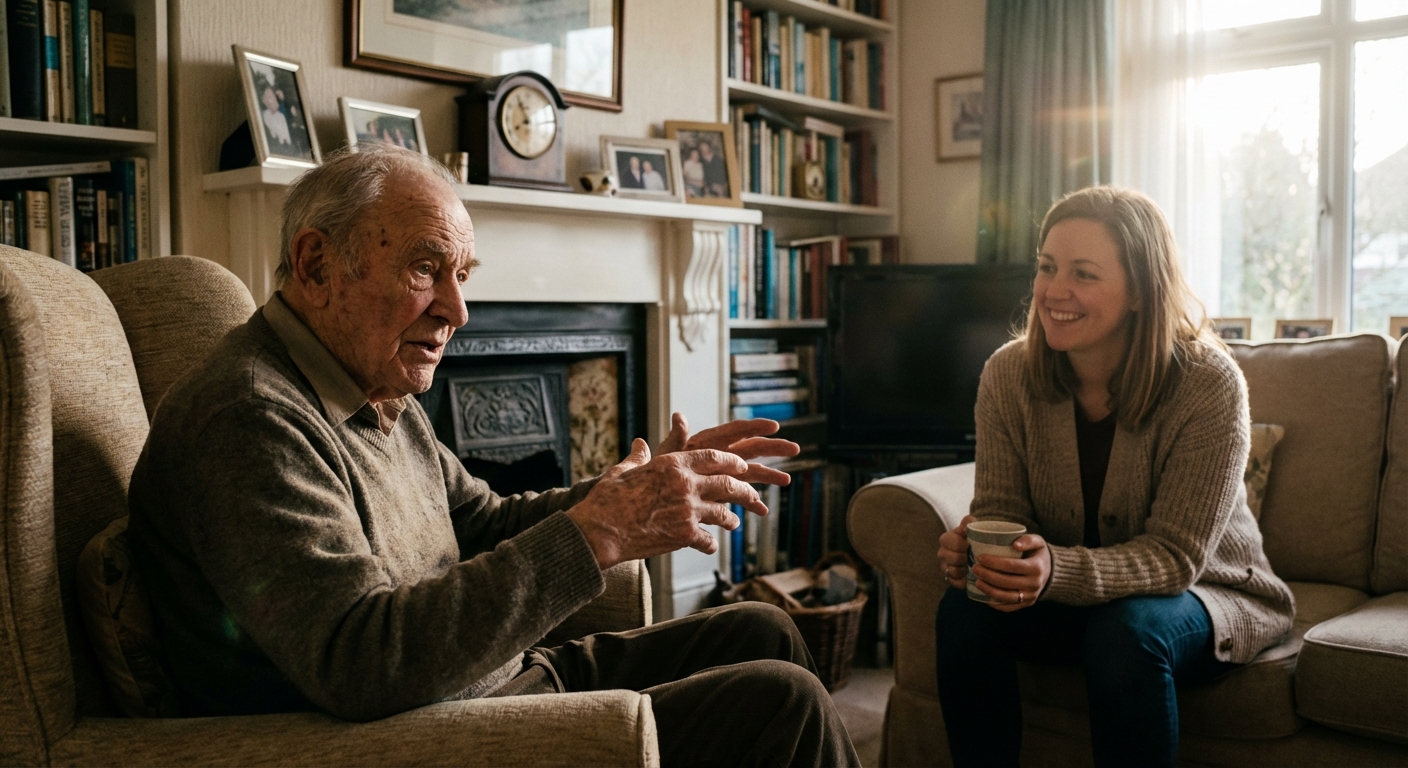
A practical guide to questions that draw out rich, detailed stories – not one-word answers.
You’ve decided to record a conversation with someone you love. Maybe it’s your mum, your grandparents, or an uncle whose stories you’ve always meant to capture. You’ve got a device ready, a cup of tea poured, and a vague plan to “just ask some questions.”
Here’s the thing: the questions you ask will shape everything. The difference between a stilted, awkward recording and a vivid, moving one almost always comes down to how you frame your prompts.
When you’re recording family history – whether audio or video – you need questions that invite stories, not bullet points. “Where did you grow up?” gets you a place name. “What do you remember about the street you lived on as a child?” gets you the sound of the ice cream van, the neighbour who grew enormous dahlias, the crack in the pavement where your mum once tripped carrying the shopping.
That’s the kind of detail that makes a recording worth keeping. Let’s look at the questions that get you there.
Memory Trigger Questions
These questions are designed to surface vivid, sensory memories. They work by anchoring the conversation in specific details – a place, an object, a smell – rather than asking someone to summarise large chunks of their life.
The trick is to aim for the small and concrete. Big questions (“What was your childhood like?”) tend to produce big, vague answers. Narrow questions open the floodgates.
Try these:
-
“What did your childhood bedroom look like?” – This anchors the memory in a physical space. You’ll often hear about shared beds, wallpaper patterns, toys kept under the pillow, the view from the window. One detail leads to the next.
-
“What was the first meal you learned to cook, and who taught you?” – Food memories are extraordinarily powerful. This question usually unlocks a whole scene: the kitchen, the person teaching, what went wrong the first time.
-
“Can you describe a typical Sunday when you were about ten years old?” – Picking a specific day of the week and a rough age gives the brain something to latch onto. You’ll hear about routines, rituals, and the people who filled them.
-
“What sounds do you remember from your childhood home?” – This is a wonderful one for recordings specifically, because it invites the storyteller to pause and really listen to their memory. Radio programmes, arguments through walls, birdsong, a parent’s laugh.
-
“What was the journey to school like?” – Walking routes, bus rides, friends met along the way, the weather, the dread of Monday mornings. A journey is a natural narrative structure, which makes it easy to answer at length.
-
“Do you remember a smell that takes you straight back to a particular moment?” – Smell is the sense most strongly tied to memory. This question often produces the most surprising and emotional answers.
-
“What was the first thing you saved up to buy with your own money?” – This reveals values, desires, and a sense of what mattered at a particular age. The story around the saving is usually richer than the object itself.
Storytelling Prompt Questions
Memory triggers unlock scenes. Storytelling prompts go further – they invite a narrative arc. These questions naturally encourage a beginning, middle, and end, which makes for recordings that are genuinely compelling to listen to later.
The key phrase here is “Tell me about a time when…” – it signals that you want a story, not a fact.
-
“Tell me about a time you were really brave.” – Compare this to “Were you brave?” (which gets a yes or no). This version invites a specific incident with stakes, tension, and resolution.
-
“Tell me about the day you met [partner/spouse]. What happened?” – Love stories are universally fascinating, and most people remember this day in remarkable detail. The question works because it asks for a sequence of events.
-
“What’s the hardest decision you’ve ever had to make?” – This draws out not just the decision itself but the circumstances around it, the people involved, and what happened afterwards.
-
“Tell me about a time something went completely wrong but turned out fine.” – People love telling these stories. They have natural drama and usually end with a laugh or a lesson. Perfect for a recording.
-
“What’s the proudest moment of your life so far?” – Adding “so far” keeps the question warm and open rather than final. It invites reflection without pressure.
-
“Tell me about a friendship that really shaped you.” – This opens up stories about loyalty, adventure, falling out, growing apart, or growing up together. It often surfaces people and events that wouldn’t come up in a standard family history interview.
-
“Was there a moment when your life changed direction? What happened?” – Turning points make for powerful recordings. People tend to narrate these with real clarity because they’ve often thought about them before.
Values and Wisdom Questions
These are the deeper questions – the ones that capture not just what happened, but what it meant. They’re best placed later in the conversation, once the storyteller is relaxed and warmed up from the earlier prompts.
Don’t rush these. Give space for silence after you ask. Some of the most meaningful moments in a recording come after a long pause.
-
“What do you know now that you wish you’d known at twenty?” – A classic for good reason. It invites reflection without being preachy, and the answers are almost always genuinely interesting.
-
“What’s the best piece of advice anyone ever gave you?” – This usually comes with a story about who said it and when, which makes it work beautifully on a recording.
-
“What do you think our family does really well?” – A lovely, affirming question that reveals values. Whether you’re asking your grandparents or your siblings, this one tends to produce answers that future generations will treasure.
-
“Is there something you believe strongly that most people would disagree with?” – This one takes a bit of trust, but it can produce the most authentic, surprising moments in an interview. It invites the real person to show up.
-
“What has been the most unexpected thing about getting older?” – This question works because it’s curious rather than sombre. It treats ageing as interesting, not sad, and people respond to that tone.
-
“What do you hope people remember about you?” – Framed gently, this is a question about identity and legacy. It’s often the answer that family members come back to listen to again and again.
-
“What makes you feel most like yourself?” – A beautifully simple question that can go anywhere. Gardening, singing, arguing about politics, walking the dog. The answer tells you something essential about a person.
Tips for Better Recordings
Great questions deserve a decent recording. If you’re serious about recording your family history, you don’t need professional equipment, but a few small choices make a big difference.
Choose a quiet space. Background noise – television, traffic, kitchen appliances – is the enemy of a good recording. A living room with the windows closed and the telly off is usually fine.
Use a proper device. Your phone’s voice recorder works perfectly well. Place it on the table between you, ideally on a soft surface (a folded tea towel works brilliantly) to reduce vibration noise.
Don’t interrupt. This is the hardest one. When someone pauses mid-story, your instinct is to fill the silence. Resist it. Pauses are where the best memories surface. Give them ten seconds before you move on.
Use follow-up prompts. The most powerful question in any interview is simply: “Tell me more about that.” When someone mentions something interesting in passing, gently pull the thread. That’s where the gold is.
Record in short sessions. Forty-five minutes to an hour is plenty. Longer sessions lead to fatigue and shorter answers. You can always come back for another conversation – and often the second session is even better than the first, because the storyteller has been thinking about it in between.
Going Deeper: The Full Family History Interview Process
Questions are only one part of a good family history recording. How you prepare, how you structure the conversation, and what you do with the recording afterwards all matter too.
For a complete guide to the interview process, see How to Interview Your Parents About Their Life.
Start the Conversation
The most important thing isn’t which questions you pick – it’s that you start. Every family has stories worth keeping, and the people who hold those stories – parents, grandparents, the uncle who never stops talking – won’t always be available to tell them. Not because of anything dramatic, but because memory fades, details blur, and life gets busy.
Pick three questions from this list. Pour a cup of tea. Press record.
You’ll be glad you did.
Willow guides your family conversation with thoughtful prompts designed for recording. Start your free trial – no credit card required.
Eine Antwort hinterlassen